Sanpdragon X Elite— battery life
For me, battery life is the single most important factor in deciding which laptop to purchase. Apple’s MacBooks have been the king in this aspect ever since Apple Silicon for macOS has been introduced, but now Qualcomm claims its latest Snapdragon chips based on Oryon is as good as the Apple’s M series. Today, let’s see if this bold claim is indeed true.

Youtube channel Max Tech did a video comparison of Surface Laptop 6 equipped with Intel Meteor Lake Ultra 7 with 47 Wh battery vs Surface Laptop 7 equipped with Qualcomm Snapdragon X Elite and 54 Wh battery. After running the same set of tests on these laptops, the Surface 7 with Snapdragon X Elite had 39% remaining battery when the Intel counterpart had 3%. This gives us good estimate of how much of energy is used for the same of tests on both laptops and relative efficiency of Qualcomm’s X Elite chip vs Intel’s:
energy drain from Intel = 47 * 0.97 = 45.59
energy drain from Qualcomm = 54 * 0.61 = 32.94
relative energy efficiency = 45.59 / 32.94 = 1.38
Hence, we see about 38% efficiency gain from the Snapdraon X Elite compared to Intel’s. In fact, this calculation assumes that CPU/GPUs are the only source of power consumption, which isn’t true at all— the LCD displays of the laptops also draw significantly power and should be similar between the two. If we take this into account, we will see even larger efficiency gain of the Qualcomm chip over Intel.
Let’s have a look at another Youtube video, this time by Notebook Check. Again, the result shows much better power efficiency for Snapdragon X Elite compared to Intel or AMD chips. For instance, at 35W power draw, the Qualcomm’s chip scores 18.0 points/watt whereas Intel’s chip scores mere 14.5 points/watt, resulting in 24% better efficiency. At lower wattage, say 20W, the gain is even larger around whopping 55% according to their test results.
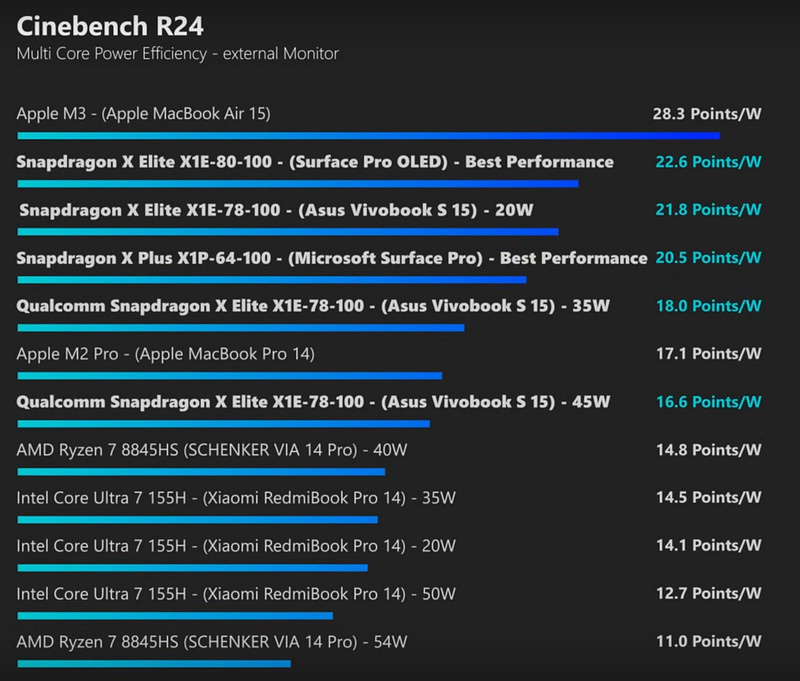
https://youtu.be/ZN2tC8DfJnc by NotebookcheckReviews
Let’s have a look at one more video, this time by Just Josh. According to his experiments, Snapdragon X Elite chips offer only moderately better power efficiency compared to Intel’s offerings, while only on-par compared to AMD’s offering. We can roughly approximate 700 points for Intel’s vs 850 points for Snapdragon X Elite at 35–40W range, resulting in 21% better efficiency.
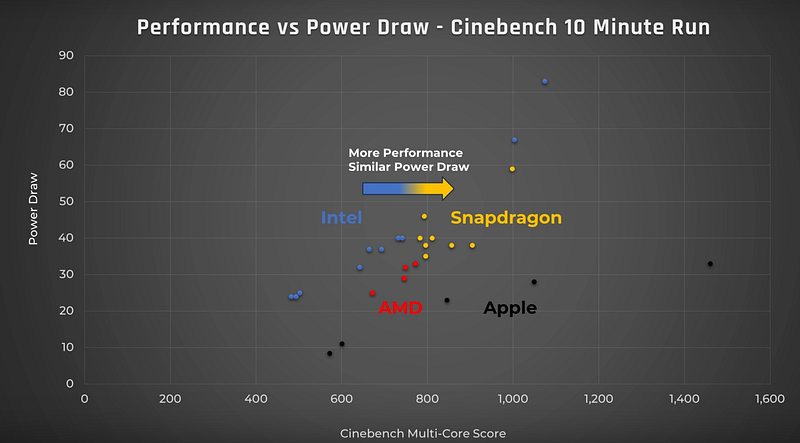
https://youtu.be/elpeaSO0MtY by Just Josh
Conclusion
From these different sources, my conclusion is that Snapdragon X Elite is definitely more efficient than Intel, but not as large as I hoped, especially at high power settings. From the last two reviews, we can safely conclude that M3 chips from Apple is still the crown in power efficiency by a large margin. There are two contributions I can think of
- Apple’s M3 chips are fabricated based on the 3nm node process whereas Qualcomm’s X Elite chips are from the 4nm node. Though not significant, the newer process node of M3 does give some advantage over Qualcomm’s
- X Elite does not have any efficiency cores, whereas M3 chips have 4 efficiency cores. This is probably because X Elite was originally designed for servers and optimized for maximal performance over power efficiency. My hunch is that Qualcomm wanted to first launch laptop processors but did not have enough time to re-design efficiency cores just yet.
In any case, the mobile chipset war between Apple, Qualcomm, AMD, and Intel is becoming more and more interesting!